Explore technical and instructional experience in enterprise cybersecurity, AI security, public safety, system integration, automation, and technology evaluation. These contributions inform EO’s capabilities and are not EO-delivered client engagements.
Scroll over the project cover or use Previous / Next to turn between projects. The page stays in place as the project changes.
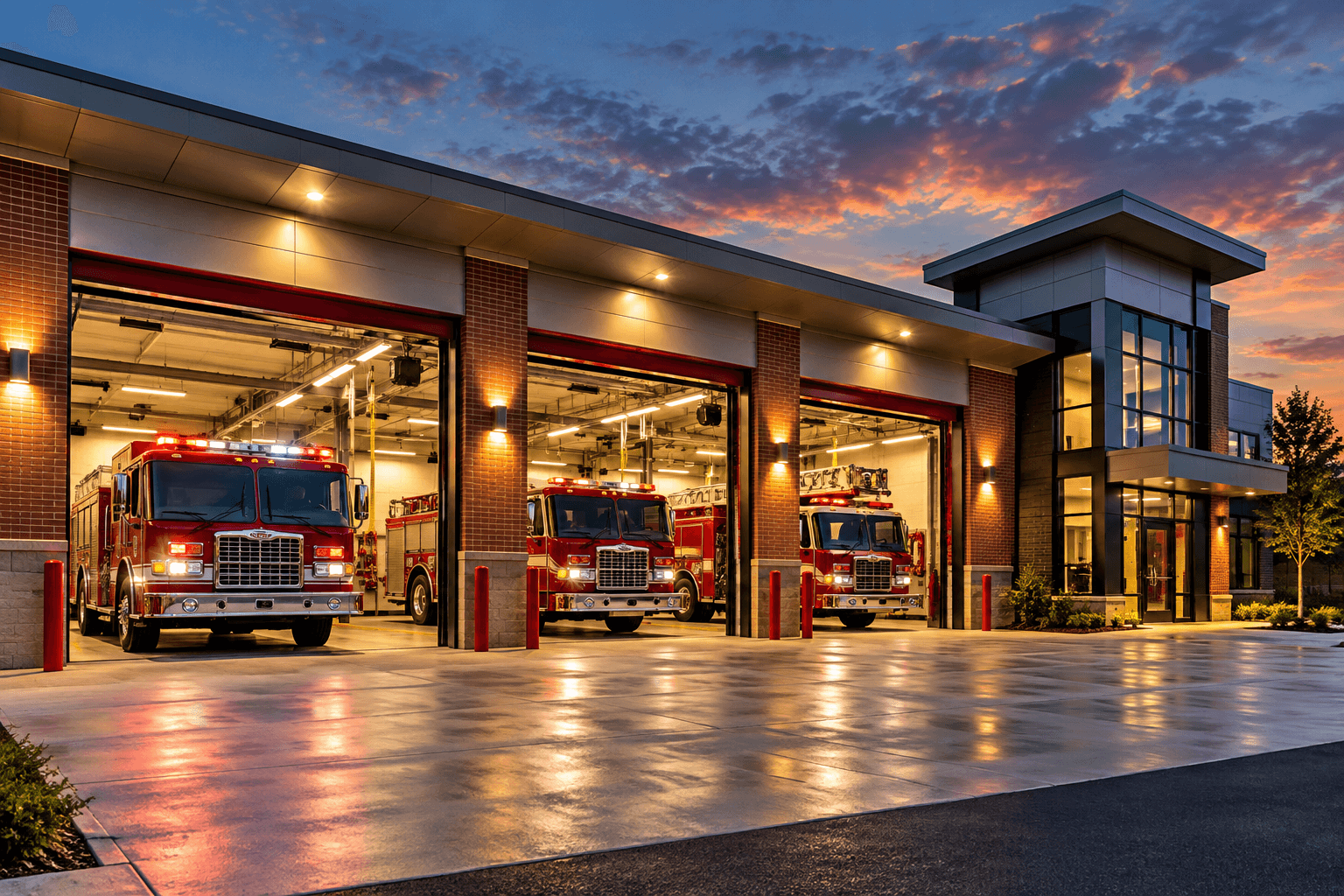
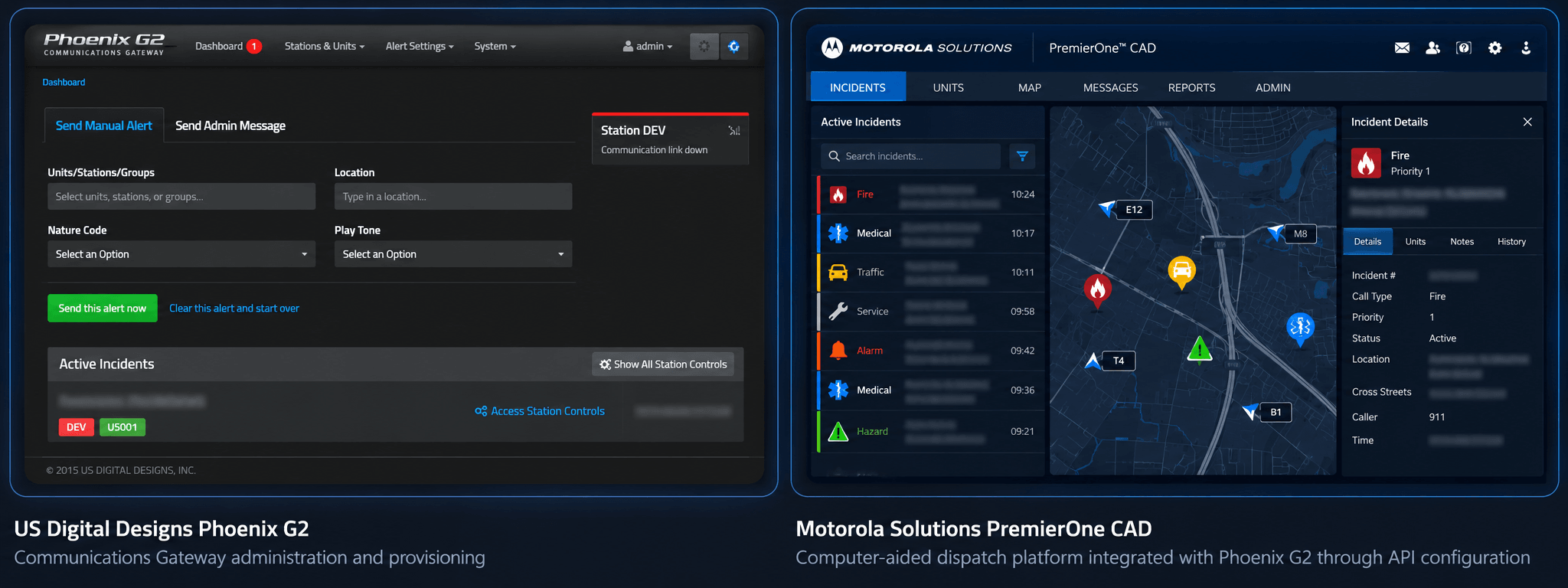
Illustrative image — not an actual project location.Technology Integration — Phoenix G2 and Motorola PremierOne CADIllustrative interface showcase. Phoenix G2 imagery is based on a supplied reference screenshot with identifying details obscured. The PremierOne CAD interface is conceptual and does not represent an actual operational deployment.
Featured professional experience · Public safety systems engineering
Regional Fire Station Alerting Integration
US Digital Designs Phoenix G2 · Motorola PremierOne CAD
100+ fire stations in regional deployment scope
Project role: Regional Public Safety Applications Project Lead, during previous employment
Led the Regional Public Safety Applications team's workstream for the implementation of the Phoenix G2 station alerting platform across more than 100 fire stations. The work focused on application administration, CAD integration, system provisioning, access oversight, and operational troubleshooting. Physical hardware installation was managed through a separate project workstream.
Technical delivery responsibilities
CAD integration: Configured the API connections linking Motorola PremierOne CAD to the Phoenix G2 alerting platform.
Communications Gateway: Administered the Communications Gateway Dashboard and performed system provisioning.
Station and mobile administration: Administered the Station Controller Interface and FSA Mobile application.
Controller support: Assisted with programming and troubleshooting ATX Station Controllers, without claiming responsibility for physical hardware installation.
Security administration: Audited user permissions and role-based access control (RBAC) assignments.
Operational investigations: Reviewed application logs to investigate missed alerts and potential misconfigurations.
Workstream leadership: Coordinated the applications team's implementation, configuration, integration, and troubleshooting responsibilities within the larger deployment.
Engineering value
The work demonstrates leadership of a mission-critical application workstream alongside hands-on enterprise integration, distributed platform administration, access-control auditing, and operational issue investigation.
This work was performed in a previous professional role, not under an Engineering Opportunities contract. Product names identify technologies only and do not imply endorsement or affiliation. No agency or employer is identified in this case study.
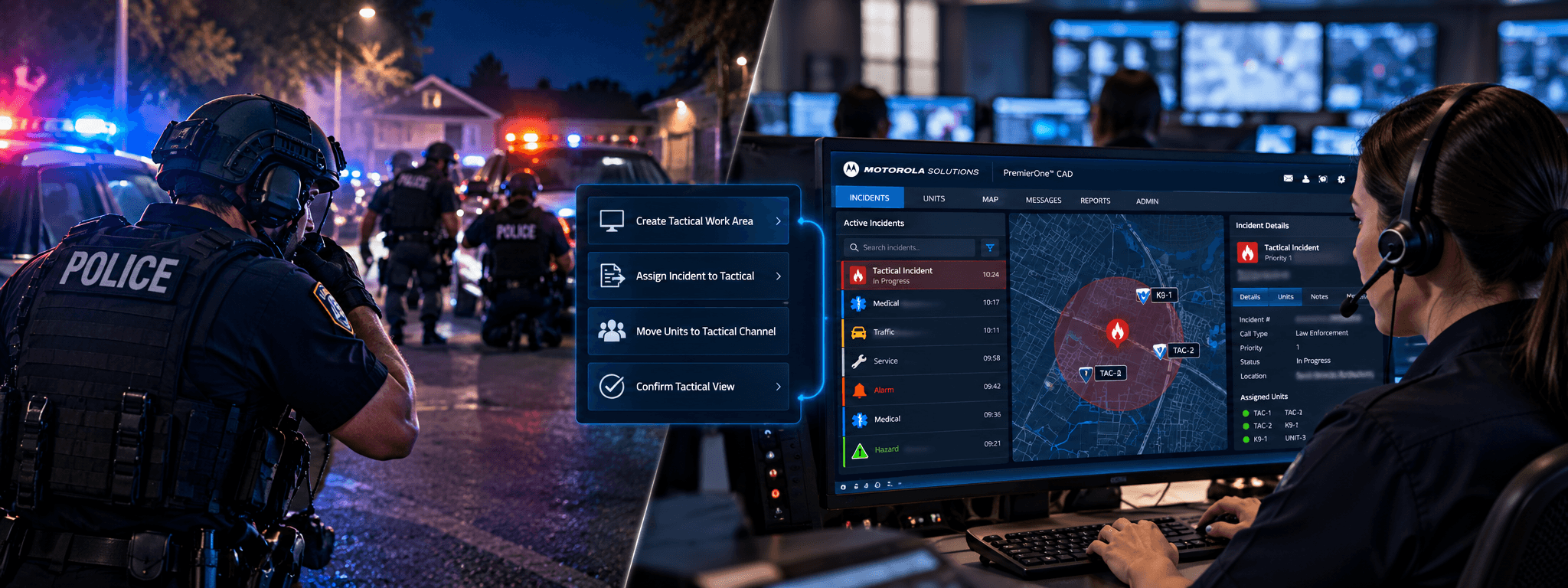
Conceptual illustration of tactical dispatch coordination. Not an actual incident or operational CAD screenshot.
Featured professional experience · Mission-Critical Systems Engineering | Public Safety Technology
Project role: Solution Designer, Systems Administrator & Workflow Developer
Professional setting: Prior professional role
The operational challenge
Following implementation of Motorola PremierOne CAD, a public safety communications organization identified a significant operational limitation. During high-priority law enforcement incidents, dispatch personnel needed to transfer active incidents and assigned police units from the primary dispatch environment into a dedicated tactical work area — giving tactical dispatchers a focused view of the emergency and its assigned response units while allowing primary dispatch operations to continue without unnecessary disruption. At the time, the proposed workaround required responding personnel to log out of their mobile CAD sessions and log back into a separate tactical work area, introducing additional steps during time-sensitive operations.
The engineering solution
A configuration-based alternative was independently designed and implemented using native Motorola PremierOne CAD capabilities. The solution combined existing application features to address an operational requirement that lacked a suitable vendor-provided workflow at the time.
Custom tactical work areas: Created dedicated tactical dispatch work areas to separate active emergency incidents from routine dispatch activity.
Custom CAD commands: Developed application-level commands and configuration logic to support incident routing into the tactical dispatch environment.
Incident transition: Configured designated incident fields to support command-driven incident transfers.
Unit movement: Adapted existing CAD unit-movement capabilities, originally associated with fire rescue operations, to support the transition of law enforcement units into the tactical work area.
Operational continuity: Designed the process to avoid requiring responding officers to log out and log back into their mobile CAD sessions.
Operational implementation
Implementation responsibilities included establishing the operational workflow, training technical coworkers and public safety subject matter experts, producing procedural documentation, and explaining its use during active emergency operations.
The described technical contributions were made during prior professional employment. The project was not performed under contract by Engineering Opportunities. The accompanying imagery is conceptual and does not depict an actual operational incident or system configuration.
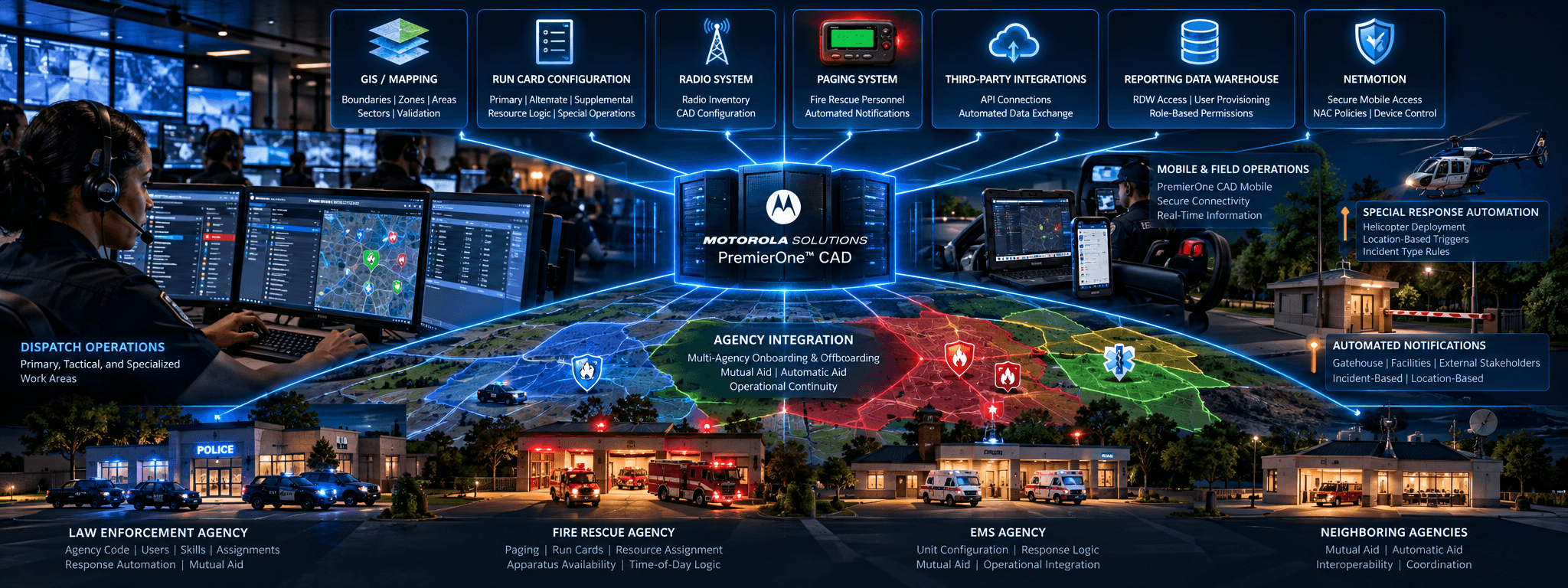
Conceptual illustration of regional public safety systems integration, agency onboarding, emergency response automation, and interconnected technologies. Not an actual operational system diagram.
Featured professional experience · Public Safety Systems Integration
Regional Public Safety Agency Integration & Technology Transitions
Engineering Mission-Critical Technology Across Multiple Public Safety Organizations
Project role: Technical Team Lead | Public Safety Systems Administrator | Integration Specialist
Professional setting: Prior professional role
The operational challenge
Integrating police and fire rescue agencies into a regional emergency communications environment requires coordinating a complex combination of technology, geography, personnel, operational procedures, and interagency relationships. Every participating agency has unique service boundaries, response requirements, staffing assignments, radio configurations, reporting needs, mobile technology, and security permissions — and all of it must be accurately translated into enterprise CAD configurations and interconnected operational systems. Agency transitions also require careful coordination when dispatch responsibilities move between organizations, particularly where mutual aid, reporting access, automated notifications, and third-party integrations are involved.
Technical leadership and agency coordination
The work included technical team leadership for onboarding and offboarding law enforcement and fire rescue agencies within a regional Motorola PremierOne CAD environment, directly coordinating with police chiefs and command staff, fire chiefs, captains, and fire rescue administrators, public safety communications leadership, technical implementation teams, field personnel and agency subject matter experts, and neighboring and receiving dispatch organizations. Each engagement required translating agency operational requirements into application configurations, deployment activities, and interagency technical workflows.
Core engineering contributions
Eight interlinked capability areas, including hands-on HipLink administration and PremierOne CAD API integration. Expand each card for technical details.
A · Agency provisioning & GISBoundaries, zones, dispositions, user accounts
Provisioned agency identifiers and application configurations.
Configured geographic boundaries, zones, areas, and sectors.
Validated geographic boundaries and dispatch behavior.
Configured incident signals, ten-codes, dispositions, user skills, and assignments.
Provisioned user accounts and operational permissions.
B · Emergency response logic & run cardsPrimary, alternate, and supplemental response recommendations
Configured primary, alternate, and supplemental run cards supporting response recommendations and resource assignments based on:
Incident type and location.
Geographic service boundaries.
Apparatus and resource availability.
Direction of travel.
Time-of-day conditions.
Special operational requirements.
Included developing alternative response configurations for situations where the preferred complement of emergency resources was not immediately available.
C · Automated response & notificationsSpecialized automation for operational workflows
Helicopter deployment triggers.
Incident- and location-based notification workflows.
Automated notifications to designated facilities or external stakeholders.
Application-driven third-party information delivery.
D · HipLink notifications & fire rescue pagingCAD API integration, notification rules, recipient groups, and platform administration
Served as one of the HipLink administrators, configuring the API integration with Motorola PremierOne CAD and managing agency-specific notification services.
Configured PremierOne CAD-to-HipLink API connectivity for automated notification workflows.
Designed and maintained notification rules and recipient groups according to agency operational requirements.
Administered the HipLink application and supported ongoing operations.
Provisioned HipLink configurations during agency onboarding and handled related changes and deprovisioning during offboarding.
Separately provisioned paging system configurations for fire rescue personnel.
HipLink notification administration and fire rescue paging are distinct responsibilities; no unverified integration between the two is implied.
E · Mutual aid & automatic aidInteragency response configurations
Worked with neighboring agencies to configure CAD response for both mutual aid (requested on demand) and automatic aid (dispatched by prearranged agreement), based on:
Incident type.
Geographic location.
Available resources.
Home-agency resource availability.
Interagency response requirements.
F · PremierOne CAD Mobile & radioMobile deployment, radio configuration, field support
Configured agency radio inventory information within PremierOne CAD.
Supported CAD Mobile deployment and configuration.
Installed and configured CAD applications at local agency facilities where authorized.
Assisted field personnel with application functionality.
Developed training materials and provided instruction as needed.
G · Security, access & reportingIdentity, RBAC, RDW, and secure mobile connectivity
User provisioning and deprovisioning.
Role-Based Access Control (RBAC).
Reporting Data Warehouse (RDW) access provisioning.
NetMotion Mobility policies.
Network Access Control (NAC) configurations.
Secure mobile application connectivity.
NetMotion is described here as an enterprise mobility and secure connectivity platform. The project responsibilities did not include the complete server architecture or the full VPN infrastructure.
H · Third-party API integrationsPremierOne CAD–HipLink and other authorized integrations
Configured the API integration between Motorola PremierOne CAD and HipLink to support automated notifications, alongside other authorized third-party application interfaces. Confidential endpoints, credentials, commands, and implementation details are intentionally omitted.
Agency offboarding and transition engineering
During agency departures from the regional dispatch environment, technical transition work included coordination with receiving dispatch organizations to support operational continuity.
Deprovisioning: Removed agency access and configurations in a controlled sequence.
Receiving-side coordination: Worked alongside cooperative dispatch centers assuming operational responsibility.
API continuity: Configured the API communications necessary for the receiving organization.
Reporting access: Supported Reporting Data Warehouse (RDW) access requirements for the transition.
Workflow translation: Explained operational workflows and system dependencies to the receiving teams.
Stakeholder coordination: Worked with chiefs, captains, and other project stakeholders throughout the transition.
The documented technical work was performed in prior professional roles. It does not represent a project contracted to Engineering Opportunities. The illustration is conceptual, and sensitive agency-specific implementation details have been omitted.
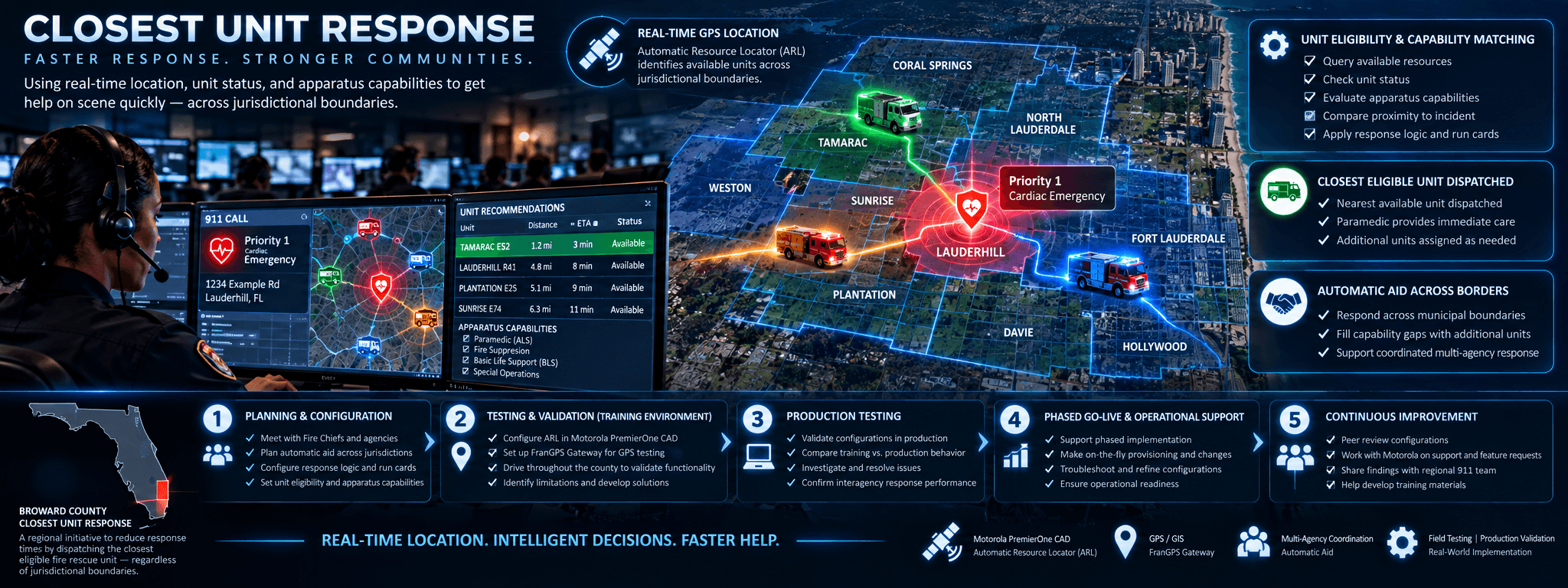
Conceptual illustration of GPS-enabled emergency response coordination, automatic aid, and phased implementation. Not an actual operational CAD display, incident record, or verified geographic routing diagram.
Closest Unit Response in Action
Watch a publicly available video about the Closest Unit Response initiative. This third-party video provides context for the countywide program; it does not document the technical contributions documented here or represent an Engineering Opportunities production.
Project role: One of the technical implementation leads · CAD configuration, field validation and phased go-live support
Professional setting: Prior professional role
The operational challenge
Emergency apparatus assigned to one municipality may be farther from a life-threatening incident than an available unit in a neighboring jurisdiction. The regional Closest Unit Response initiative aimed to use real-time resource location, availability, and operational response requirements to support timely assistance across municipal boundaries.
Engineering the response logic
Technical lead responsibilities included configuring Motorola PremierOne CAD workflows using Automatic Resource Locator (ARL), GPS-derived unit positions, resource status, geographic proximity, apparatus capabilities, and automatic-aid agreements. When permitted by response rules, a nearby unit could provide initial medical or fire suppression assistance while additional apparatus with the required capabilities responded to complete the assignment.
CAD and run-card engineering: Configured resource-selection logic, automatic-aid arrangements, and primary and supplemental run cards across neighboring jurisdictions.
Fire leadership coordination: Met with fire chiefs and stakeholders to plan interagency response requirements and test neighboring agencies' configurations.
Peer review: Evaluated configurations developed by colleagues and helped identify improvements and operational limitations.
Training-environment field validation: Configured a laptop with FranGPS Gateway and PremierOne CAD, then drove throughout the county to evaluate GPS location and dispatch behavior in the training environment.
Production validation: Extended testing into the production CAD environment, investigated unexpected results, and refined configurations.
Phased go-live engineering: Supported each rollout phase with on-the-fly provisioning, troubleshooting, and configuration changes based on findings during go-live.
Vendor collaboration and knowledge transfer: Worked with Motorola on support cases, advanced configurations and feature requests; documented findings, shared them with regional 911 stakeholders, and assisted with training materials.
This countywide initiative involved multiple organizations and contributors. This case study describes the technical contributions documented here during previous employment, not work contracted to Engineering Opportunities. Sensitive implementation details are omitted.
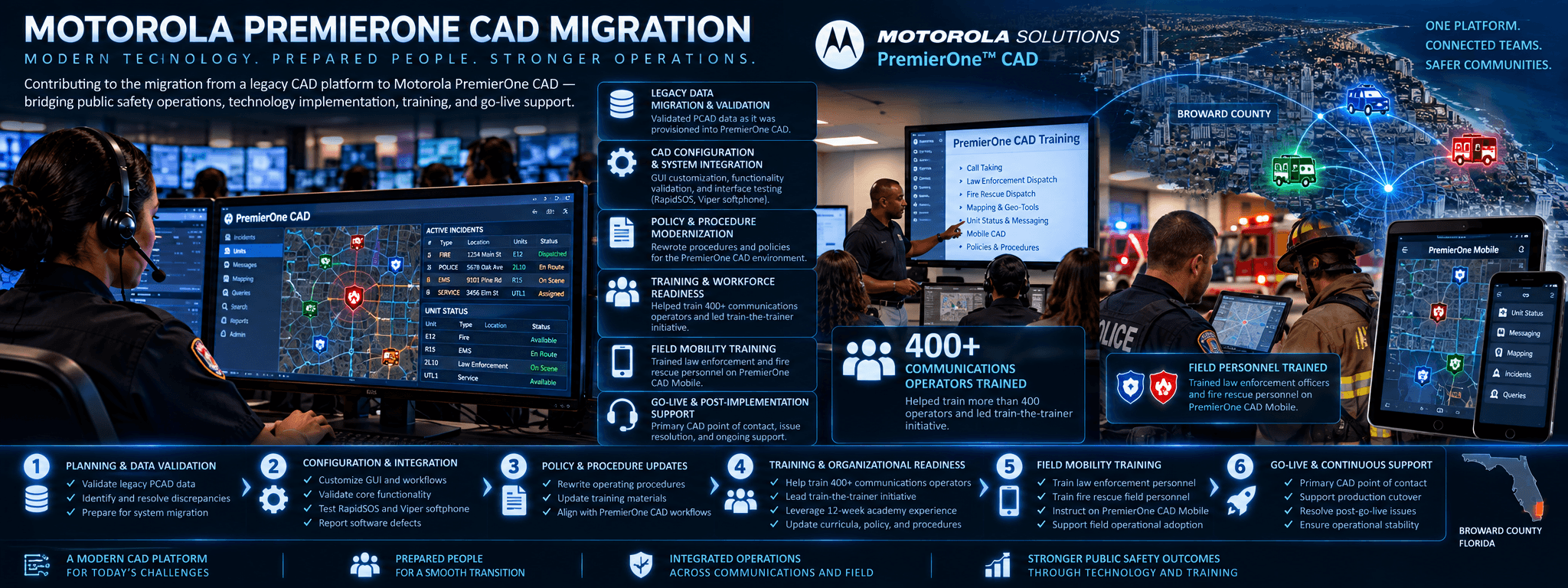
Conceptual illustration of the Motorola PremierOne CAD migration, workforce training, field mobility, and implementation support. Interface elements are illustrative and do not represent actual operational systems or records.
Featured professional experience · Mission-critical CAD migration and workforce readiness
Motorola PremierOne CAD Migration
Legacy Motorola PCAD → PremierOne CAD · Application validation · Operational training · CAD Mobile · Go-live support
Project role: One of the primary CAD technical points of contact · Train-the-trainer lead · Field mobility instructor
Professional setting: Prior professional role
The operational challenge
Migrating a public safety communications operation from legacy Motorola PCAD to PremierOne CAD required accurate data conversion, functional testing, revised workflows, updated policies, coordinated training, and cutover support for round-the-clock emergency operations.
Bridging emergency operations and enterprise technology
The migration work drew on combined experience in emergency call-taking, communications training, and information technology, including responsibility for a 12-week training academy. The academy covered emergency call-taking, law enforcement and fire rescue dispatch, codes and signals, policy and procedure, geography, and computer-aided navigation.
Legacy data validation: Worked with public safety technology stakeholders to validate information transferred from Motorola PCAD into PremierOne CAD and identify discrepancies.
Configuration and functional testing: Helped customize the CAD graphical interface, validate system behavior, recommend operational workflows, and report software defects.
Connected-system validation: Evaluated PremierOne CAD functionality and connected workflows involving RapidSOS and the Viper softphone. These contributions are not represented as necessarily occurring at the original cutover.
Policy and procedure modernization: Rewrote legacy PCAD procedures and helped update operational policies and training materials for the PremierOne CAD environment.
Train-the-trainer leadership: Served as one of the leads in preparing instructors and helped train more than 400 emergency communications operators for the platform transition.
Field mobility training: Trained law enforcement officers and fire rescue field personnel on the Motorola PremierOne CAD Mobile application.
Go-live and continued support: Served as one of the primary CAD contacts, assisted with production cutover, and helped investigate and remediate issues discovered during and after deployment.
The documented work was performed in prior professional roles, not as an Engineering Opportunities client engagement. The migration was a collaborative project involving multiple organizations and technical teams. The linked product demonstration does not depict the specific implementation described here.
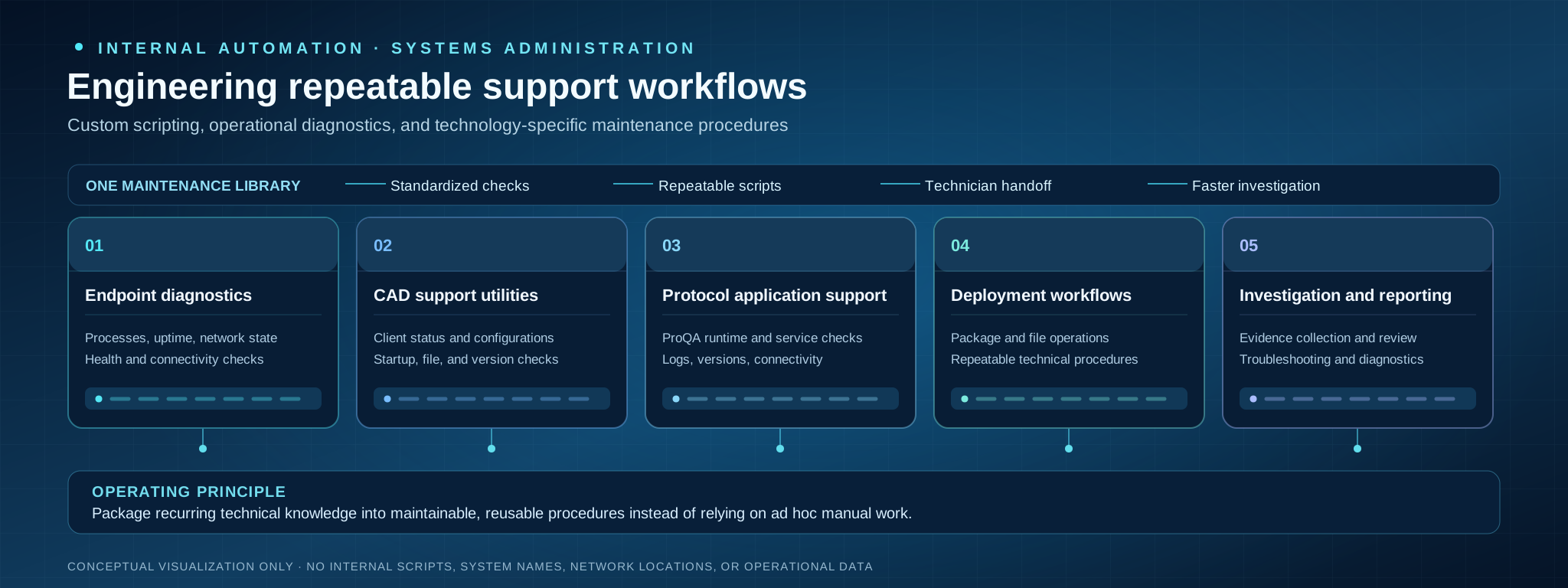
Original conceptual illustration of categories of custom maintenance scripts and supporting utilities. Not an actual system screenshot, script inventory, or operational environment.
Featured professional experience · Systems automation & mission-critical application support
Engineering a Custom Systems Administration Automation Toolkit
Windows Scripted Administration · Diagnostics · CAD Client Maintenance · ProQA Application Support · Deployment Tooling
Project role: Systems Administrator · Custom Scripting & Workflow Automation
Professional setting: Regional public safety technology operations · Prior professional employment
The operational challenge
Supporting enterprise public safety applications involved frequent, repetitive technical tasks: checking application status, inspecting client workstations, collecting diagnostic information, verifying configuration files, and preparing systems for upgrades or troubleshooting. At the time, the team did not yet have funding for the commercial endpoint-management platforms that could centralize many of these activities.
Before commercial endpoint-management funding was available, an extensive library of custom scripts and maintenance utilities was developed to turn recurring technical tasks into repeatable workflows. This work predates today's widely available AI-assisted software development tools.
From recurring tasks to reusable technical tools
Historical screenshots of the maintenance library show tool categories addressing:
01 · DiagnosticsEndpoint & process health
Client uptime, running processes, network-interface details, service status, and connectivity investigation.
02 · CAD operationsMission-critical client support
Application version checks, running-program and service inspection, communication and socket connectivity, and log review.
04 · Repeatable workDeployment & maintenance
Scripted application updates, file-copy and replacement tasks, workstation inventory, and other procedures prepared for repeatable execution.
05 · TroubleshootingTechnical investigation
Diagnostic collection, error investigation, environment checks, and support tasks that otherwise required multiple manual steps.
Operational engineering approach
The library combined custom-authored scripts with existing operating-system and third-party administrative utilities. The folder listings demonstrate the breadth of tasks addressed but should not be mistaken for a claim that every executable was custom-written, every folder represented a released product, or every experimental script was deployed. Its architectural value was organizing support procedures so recurring work could be performed more consistently and technical knowledge could be reused.
The same practical approach appears in the independently developed deployment automation for protocol-based dispatch applications: application provisioning, logging, rollback, and native Windows console notifications were designed so another IT specialist could execute a procedure without requiring the original developer on-site.
This case study describes work performed in a prior professional role, not an EO client engagement. The illustration is conceptual; no code, configuration files, workstation identifiers, vendor credentials, internal file paths, or former employer names are disclosed. Existing diagnostic tools visible in historical folders are not represented as custom-developed software. No unverified productivity metrics or deployment outcomes are claimed.
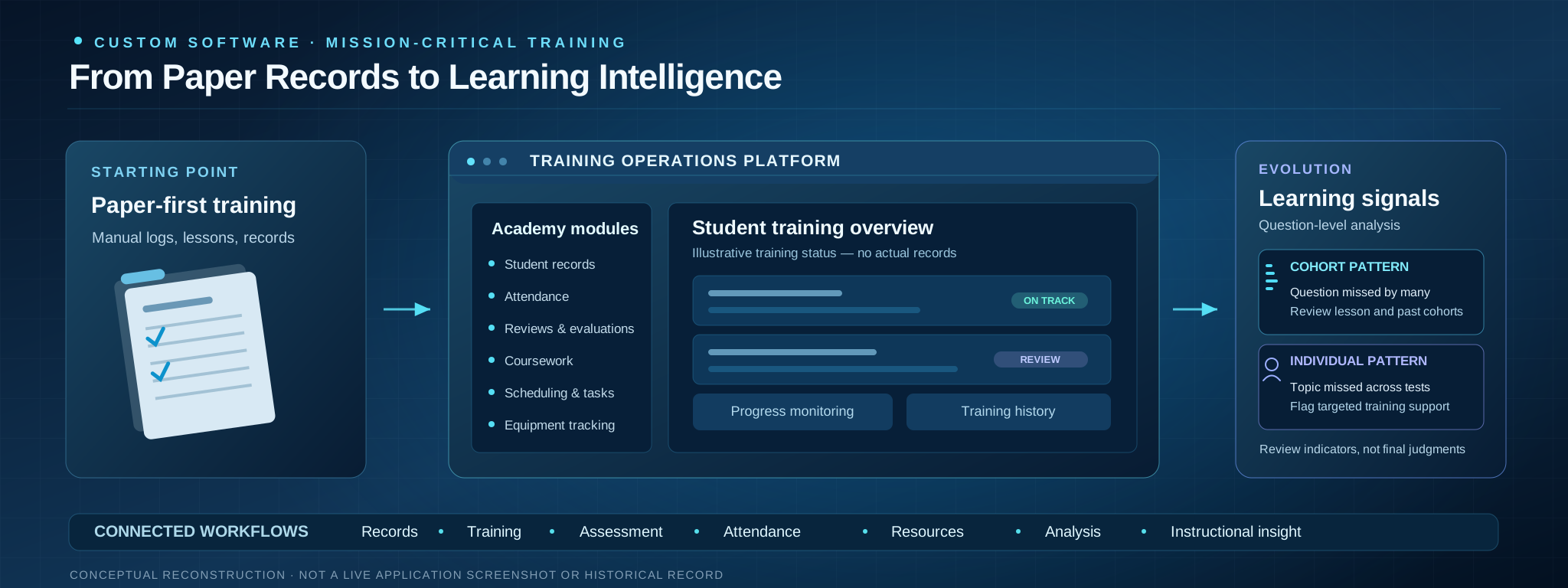
Original conceptual reconstruction inspired by historical application screenshots. No actual student information, agency branding, or internal system screenshots are reproduced.
Featured professional experience · Custom software development & training operations
From Paper Training Records to a Data-Informed Academy Platform
Custom Training Management & Analytics · Microsoft Access · Training Workflows · Reporting
Role: Sole Application Designer & Developer
Experience: Public safety communications training · Prior professional employment
The operational challenge
Work as a communications training specialist revealed an academy environment where lesson tracking, instructional materials, evaluations, and administrative processes relied heavily on paper. Locating information, following individual student progress, and connecting training activities required manual effort spread across different forms and resources.
What began as a personal effort to organize and track lessons grew into a broader solution as recurring training needs and opportunities for more useful information became apparent.
Designing an academy learning management system
The Microsoft Access-based application was independently designed and developed that expanded into a custom learning and training management system for the academy. The historical screenshots show an interconnected interface supporting multiple areas of training administration:
Student informationProfiles, registration, classification, and training records
Performance reviewsInstructor assessments, review categories, notes, and retrieval
AttendanceAttendance records, late-arrival reasons, and comments
Coursework & geographyWorkbook materials, corrections, and question lookup
Scheduling & resourcesAcademy activities, tasks, equipment, and instructional references
Reporting & analysisTraining information organized for monitoring and decision support
Additional navigation brought together operating procedures, training bulletins, external instructional resources, and mapping references. The platform made related academy workflows accessible through one application rather than isolated paper forms.
Beyond recordkeeping: question-level performance and early-warning analytics
The platform evolved beyond recording completion and assessment scores. By associating individual test questions with instructional sections and topics, the system could compare results across students, assessments, and academy cohorts, flagging patterns that warranted closer review. Two distinct types of insight helped instructors decide where to focus attention:
Academy-wide insight
Which lessons may need attention?
Signal
A low correct-answer rate on a particular question across multiple students flagged the lesson or topic associated with that question.
Comparison
Instructors could review the same lesson and question in previous academies, including whether similar patterns occurred when the lesson was taught by the same instructor.
Potential response
Review lesson clarity, instructional delivery, question wording, and student understanding before deciding what needs to change.
Individual learning insight
Where could a student need focused help?
Signal
Repeatedly missed questions within the same subject category, across multiple tests, flagged a recurring gap for one student.
Comparison
Patterns across assessments helped distinguish an isolated incorrect answer from a topic that remained difficult for that student.
Potential response
Direct additional instruction, practice, or remedial attention toward the specific category rather than treating every test score as an unrelated event.
These flags were decision-support indicators, not automatic judgments about instructors or students. Repeated low scores could prompt investigation into teaching, lesson design, question quality, or comprehension; the pattern alone did not establish the cause.
These examples describe the question-level analytical approach and the platform's evolution toward predictive, intervention-oriented training support. No specific machine-learning architecture, validated forecast accuracy, or measured operational improvement is claimed.
This application was independently developed in a prior professional role, not as an Engineering Opportunities client project. The accompanying diagram is a conceptual reconstruction. Identifying details, original academy names, insignia, student records, contact information, and internal application screenshots have intentionally not been published.
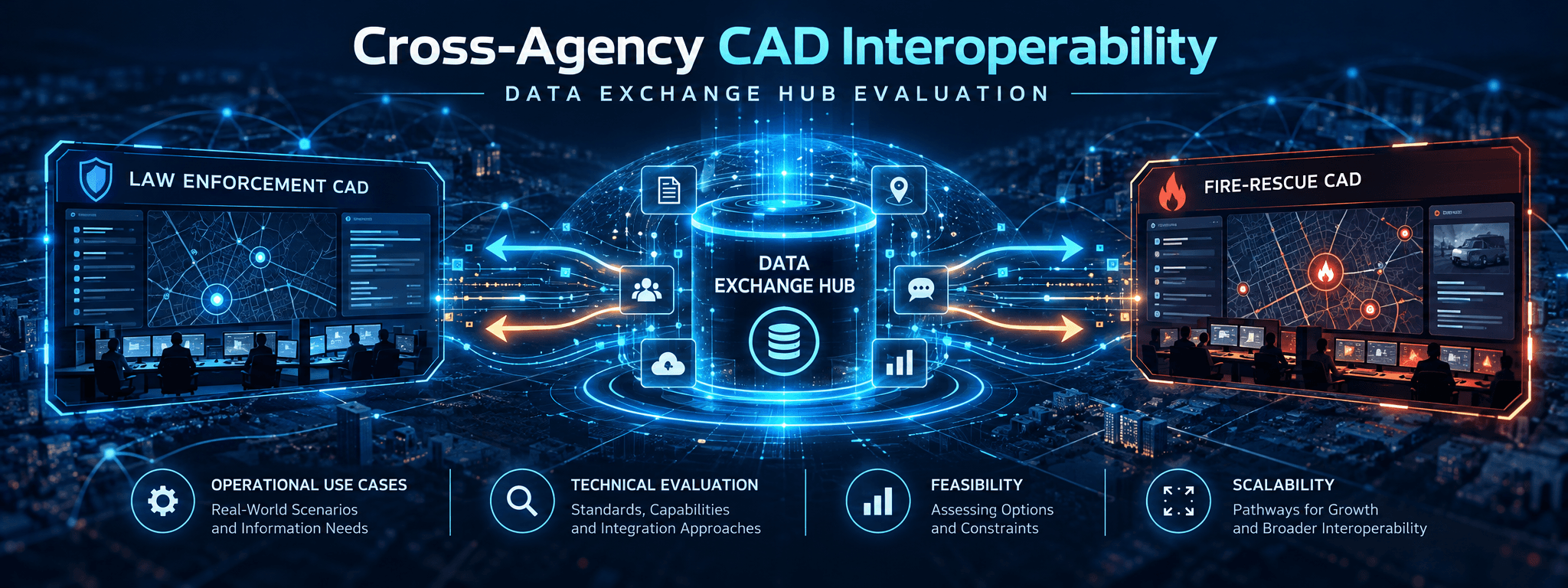
Conceptual illustration of a cross-agency CAD interoperability evaluation. Created for portfolio presentation; not an actual system architecture, production deployment, or verified representation of the evaluated product.
Featured professional experience · Emergency communications interoperability assessment
Evaluating Cross-Agency CAD Interoperability — Data Exchange Hub
Disparate CAD Environments · Emerging Digital Concepts Data Exchange Hub · Operational Use-Case Design · Technical Feasibility
Project role: Technical Evaluation Team Member · Author of Operational Evaluation Use Cases
Professional setting: Prior professional employment in regional public safety technology operations
Why interoperability mattered
In the aftermath of a major 2018 school shooting, public safety stakeholders examined the need for more effective information exchange between separately operated computer-aided dispatch (CAD) systems supporting law enforcement and fire-rescue response. The question was how distinct dispatch environments might share relevant operational information while serving different agencies and responsibilities.
The incident provides important context for the evaluation, but this case study does not assign responsibility for incident outcomes to a technology platform or claim that any proposed integration would have altered the emergency response.
Designing the evaluation around real dispatch operations
The technical delegation traveled to the National Capital Region to evaluate Emerging Digital Concepts' (EDC) Data Exchange Hub as a potential interoperability solution. The team was assessing its suitability for exchanging information across disparate public safety CAD environments.
Because of prior experience as a 911 call-taker, law enforcement dispatcher, communications training specialist, and IT specialist, the evaluation role included responsibility for creating the comprehensive set of operational use cases used to challenge the solution during evaluation. These complex scenarios were deliberately designed to push the Hub's capabilities and help the team assess technical feasibility, scalability, and how proposed information-sharing behaviors aligned with actual emergency communications work.
Technical evaluation responsibilities
Operational use-case ownership: Developed the evaluation scenarios, drawing on hands-on knowledge of call-taking, law enforcement dispatch, training, and public safety technology administration.
Cross-system perspective: Framed the assessment around coordination between independently operated dispatch environments rather than assuming a single CAD system or workflow.
Rigorous solution evaluation: Constructed demanding cases intended to explore the Hub's limits, scalability considerations, and suitability for the identified interoperability need.
On-site technical participation: Participated in the team evaluation of the vendor's solution in the National Capital Region.
This case study describes the technical contributions documented here during prior professional employment, not work performed for Engineering Opportunities. It documents evaluation and use-case development, not a completed implementation, vendor certification, independently verified scalability result, or operational deployment. Former employers, agency identifiers, sensitive scenarios, and evaluation findings are intentionally omitted. The mention of Emerging Digital Concepts identifies the product evaluated and does not imply endorsement or a commercial relationship.
Ongoing professional experience · Academic instruction
Cybersecurity Education & Workforce Development
Adjunct Professor · Cybersecurity instruction · AI security
Academic instruction for law enforcement officers, water utility personnel, school district information security staff, CISOs, SOC analysts, IT professionals, and database administrators connects cybersecurity concepts to practical operational needs.
Comprehensive Cybersecurity
Broad cybersecurity instruction for practitioners across public and private sector environments.
Cybersecurity for Artificial Intelligence
Intensive, laboratory-based instruction covering machine learning and large language models, prompt injection, data poisoning, model evasion, and sensitive data leakage. Red-team and blue-team exercises against live AI chatbots explore layered defenses, Zeek network analysis, anomaly detection, and threat-hunting metrics.
Instruction incorporates NIST AI Risk Management Framework, NIST Cybersecurity Framework 2.0, MITRE ATLAS and ATT&CK, and OWASP Top 10 for LLM Applications.
Operational relevance
This ongoing professional experience informs EO’s approach to cybersecurity, AI governance, and workforce readiness. It is not an EO-contracted engagement.
Featured professional experience · Enterprise cybersecurity
Responsible for deployment and operational support of endpoint detection and response (EDR) capabilities across a large, dynamic enterprise computing environment. The work requires maintaining visibility into a changing population of managed compute assets, including systems that may be online, offline, or short-lived.
Technical responsibilities
EDR deployment: Support the rollout and ongoing operation of endpoint detection and response controls across enterprise compute infrastructure.
Dynamic asset visibility: Work with compute inventory spanning online, offline, and ephemeral workloads, where asset records and active protection coverage require careful distinction.
Detection and prevention: Support security visibility, detection, and prevention capabilities through enterprise endpoint security tooling.
Operational consistency: Develop and maintain documentation for security processes, helping turn institutional knowledge into repeatable operational procedures.
Engineering relevance
Enterprise EDR operations involve more than installing an endpoint agent. The experience demonstrates how endpoint security deployment, inventory interpretation, and operational processes intersect when infrastructure is continuously changing. The description does not imply that every recorded asset is simultaneously online or protected.
This case study reflects professional experience represented within EO, not a client engagement delivered by EO. Deployment counts, configurations, and sensitive operational details are intentionally omitted.
More technical work
Additional Project Notes
Supporting application development and integration examples. These remain separate from the featured dossiers.
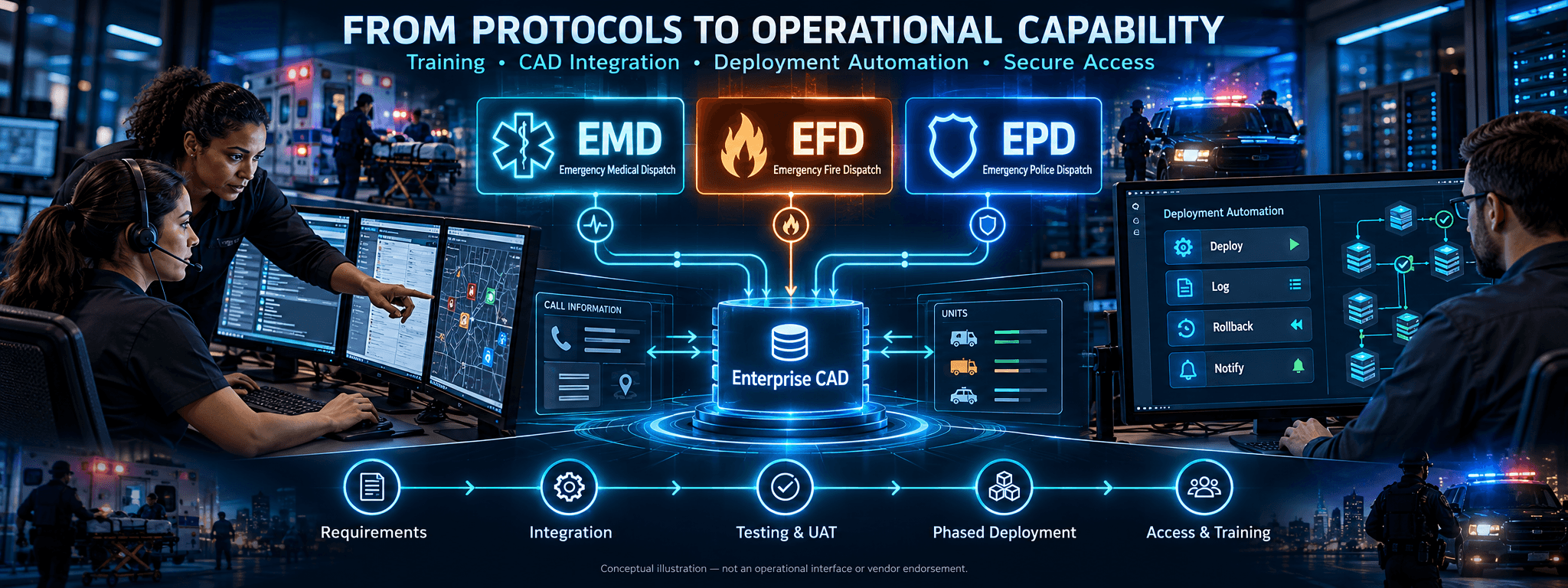
Illustrative composite — Priority Dispatch ProQA EMD / EFD / EPD protocol interfaces alongside PremierOne CAD. Not an actual deployment screenshot.
Priority Dispatch ProQA — EFD & EPD Integration and Deployment
Project Lead · Application Integration, Deployment Automation & Training · Prior professional employment
Led deployment of Priority Dispatch Emergency Fire Dispatch (EFD) and Emergency Police Dispatch (EPD) applications in a cooperative dispatch center serving more than 400 operators. The work brought together requirements gathering, Motorola PremierOne CAD integration, deployment automation, testing, application access administration, and go-live support.
Operational foundation: Earlier, as a 911 communications training officer, learned ProQA following its introduction and taught the application to new hires and employees receiving remedial training. That frontline teaching experience informed the later technical implementation.
Requirements and CAD integration: Worked with fire leadership, law enforcement stakeholders, and communications subject matter experts to gather requirements and validate data mappings. Configured middleware translating PremierOne CAD incident signals to applicable protocol cards, along with the interface returning EFD and EPD data to CAD.
Repeatable deployment automation: Built custom Windows batch-script automation covering application deployment, logging, rollback, and console notifications through native Windows messaging. The automation enabled an IT specialist with limited experience to complete deployment while the primary developer was away.
Testing and operational readiness: Performed development testing and user acceptance testing (UAT), then worked alongside communications subject matter experts during their UAT. Participated in production deployment and addressed issues during go-live through troubleshooting, configuration adjustments, vendor coordination, and guidance for center subject matter experts.
Application identity and access management: Administered identities and permissions within the application, audited accounts, removed stale accounts, and enforced least privilege.
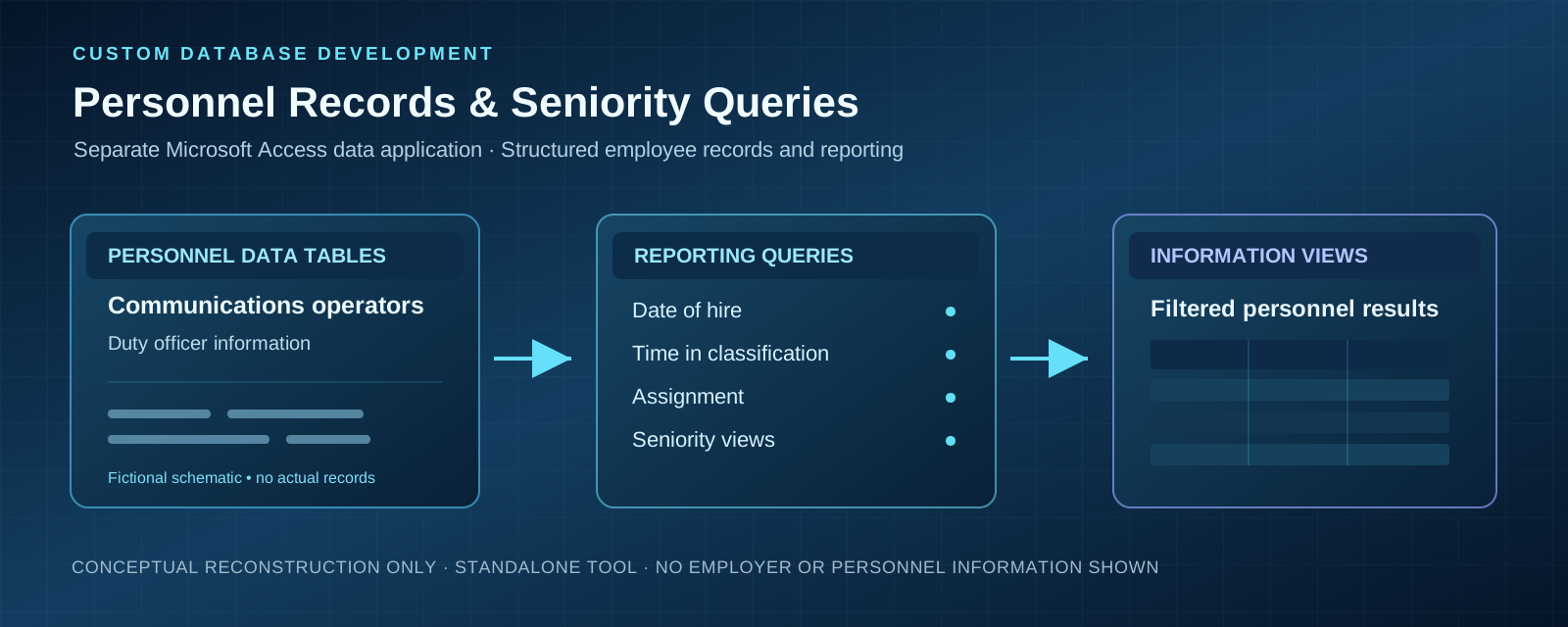
Conceptual reconstruction based on the types of tables and queries visible in historical screenshots. No employee or employer information is reproduced.
Standalone Personnel & Seniority Database
Application designer & developer · Prior professional employment
Created a standalone Microsoft Access database for employee information management, separate from the academy training platform. Historical application screenshots show communications operator and duty officer tables and query views for date of hire, time in classification, assignment, and seniority. Production adoption and access-control details have not been established.
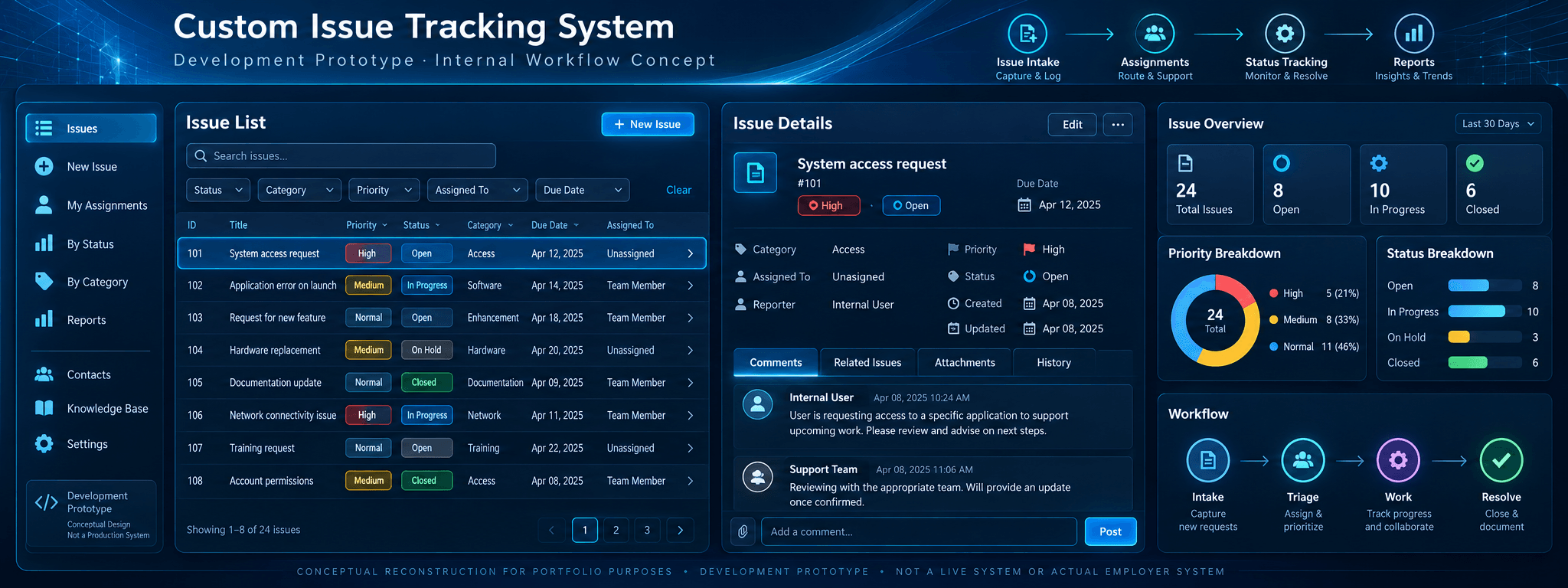
Conceptual reconstruction of an internal issue tracking system developed during prior professional employment. The application remained in development and was not released. This illustration does not depict a live production system.
Custom Issue Tracking System — Development Prototype
Application designer & developer · Not released · Prior professional employment
Developed an internal issue-tracking application prototype featuring issue records, assignments, priorities, statuses, due dates, comments, related issues, contact records, and report/navigation views. The application remained in development before development concluded and was not released. The pictured screens represent development work, not a deployed ticketing service.
Approved feedback on technical work, alongside EO’s areas of focus.
Personal testimonial
“We appreciate your intuitive extraordinary solutions in resolving our software and hardware challenges related to our computer network which was timely and on budget.”
EO capabilities
Cybersecurity & Resilience
Security strategy, risk assessment and resilient technology.
EO capabilities
Artificial Intelligence
Practical AI adoption, security and governance.
EO capabilities
Public Safety
Technology that supports mission-critical operations.
EO capabilities
Technology Integration
Connecting systems, people and possibilities.
EO capabilities
Academic & Applied Instruction
Adjunct professor experience in comprehensive cybersecurity and AI security connects education with operational practice.